

Guide
Blackjack rules for beginners: everything before the first hand
Blackjack is the table game with the smallest house edge and the most decisions, and both come from the rules. This guide sets out the rules a first-time player needs in the order they come up: what the cards are worth, what the aim is, what the five choices are, what the dealer is bound to do, and which printed rules on the table decide how much the game costs. The figures are from a published house-edge analysis and are quoted with their rule sets.
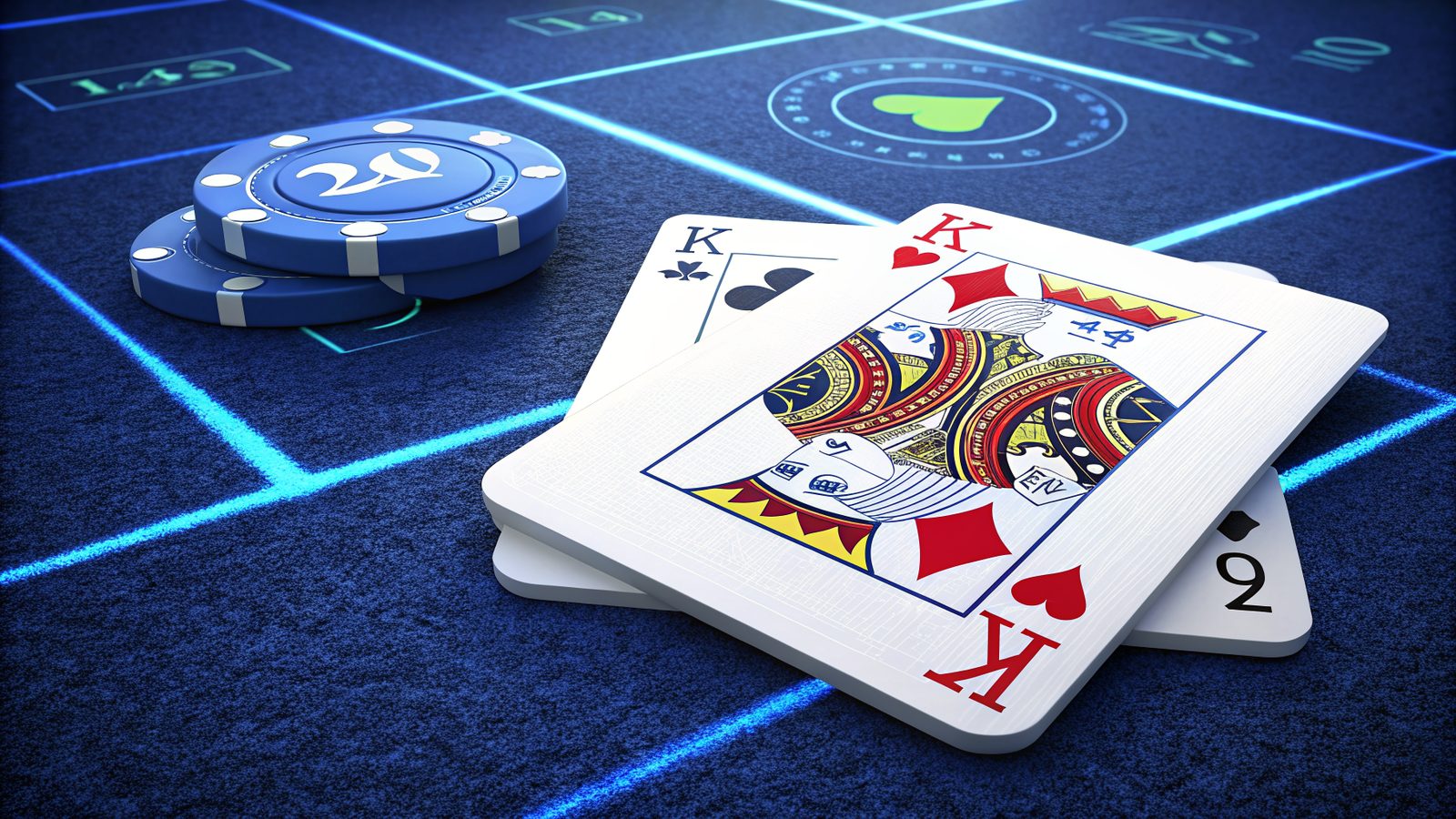
Cards, hands and the aim
Blackjack is played with one to eight standard decks of 52 cards. Aces count 1 or 11, whichever is better for the hand; 2 through 9 count their pip value; tens and face cards count 10; suits are irrelevant. Each player receives two cards face up and the dealer two, one face up. The aim is a hand total closer to 21 than the dealer's while staying at 21 or under; a hand that passes 21 busts and loses at once, whatever the dealer then does, which is where the house edge comes from. An ace with a ten-value card on the first two cards is a natural, or blackjack, and beats any other 21. A hand where an ace is counted as 11 is soft, because drawing a card cannot bust it; once the ace must count as 1 the hand is hard.
The totals in one line
- Ace: 1 or 11
- 2 to 9: face value
- 10, jack, queen, king: 10
- Over 21: bust, hand lost
The five choices
Hit: take another card, as many times as you like until you stand or bust. Stand: take no more. Double: double the stake and take exactly one more card, allowed on the first two cards and, at some tables, after a split. Split: when the first two cards are a pair, separate them into two hands with a second stake equal to the first, and play each; aces split usually receive one card each. Surrender: give up the hand and half the stake, offered at some tables before any other action. Which of these is right in each situation is a fixed answer, called basic strategy, that depends only on your hand and the dealer's face-up card, and the published house edges below assume it is followed on every hand.
The two rules of thumb a beginner most often breaks
Always split aces and eights; never split tens. Basic strategy has a hundred more lines, and a printed chart is legal at any table, live or software.
What the dealer must do
The dealer has no choices. After every player has acted, the dealer turns the hidden card, draws while the total is 16 or less, and stands at 17 or more. The variation that matters is soft 17, an ace and cards totalling six: at some tables the dealer stands on it, at others the dealer must hit, and the second rule is worth 0.22% to the house because a soft 17 that draws improves more often than it busts. The dealer's constraint is the player's edge and the player's exposure at once: the player acts first and can bust before the dealer draws, and the dealer, drawing to a fixed rule, busts often enough against a patient player to keep the game close.
Ties and naturals
Equal totals push, and the stake is returned. A dealer natural beats every player hand except a player natural, which pushes. A player natural against a non-natural dealer hand wins at the table's blackjack payout, which is the next section.
The printed rules that set the price
Four rules on the table felt or in the help panel decide the house edge, and a published analysis gives each its cost. The blackjack payout: a natural should pay 3 to 2, and a table paying 6 to 5 gives the house 1.39% more, a table paying even money 2.27% more, which are larger than the whole edge of a good game. Soft 17: dealer hits costs 0.22%. Doubling and splitting: doubling after a split and splitting to more hands each shave the edge; the Atlantic City rule set, with the dealer standing on soft 17, splitting to four hands and doubling after a split, comes to 0.43% with correct play, and the most liberal Vegas rules to 0.28%. The number of decks, one to eight, moves the figure by fractions, fewer decks favouring the player. The table game RTP guide puts those figures beside the other games.
Read the payout first
A table's blackjack payout is printed on it, and 6 to 5 is the single most expensive rule a beginner can sit down to. It is common on low-limit tables in land-based casinos and appears online in some live rooms; the help panel states it.
Playing it online
Online blackjack comes as software tables, which deal from a shuffled shoe every hand and print their return in the rules, and as live dealer tables streamed from a studio, where a real shoe is dealt and the rules are on the table and in the help panel. The rules and payouts are identical in meaning in both forms, and the choice between them is pace and atmosphere. With a bonus active, check the terms before sitting down: table games are often weighted at a fraction of the stake toward wagering or excluded, and the bonus terms guide covers the clause. The scored brands below carry a live-dealer studio in their lobbies according to the software list in their reviews; the review says which tables were available in your country.
A first session
Find a table paying 3 to 2 with the dealer standing on soft 17, keep a basic strategy chart open, and play at a stake that lets the session run through the swings, which in blackjack are gentle by slot standards and still real.
| Casino | Score | Welcome offer | Code | Not for | Link |
|---|---|---|---|---|---|
| 1xSlots Casino | 9.8 | First-deposit bonus 100% of the deposit, raised to 150% if the deposit is made within 3 hours of registering | GET100 | Poland, Hungary, Germany, Czech Republic | Play |
| Play Fortuna Casino | 9.5 | Welcome package up to $1000 + 200 FS across three deposits | GET100 | Hungary, Latvia, Estonia, Lithuania, Finland, India, Turkey | Play |
| Stake Casino | 9.5 | A welcome offer now exists, but Stake publishes no figures for it | - | Poland, Germany, Czech Republic, Lithuania, Brazil | Play |
| Vavada Casino | 9.5 | 100% first deposit bonus up to $1,000, minimum deposit $10 | GET100 | Germany, Lithuania | Play |
| Vodka Casino | 9.2 | 150% on the first deposits, plus 50 free spins for linking Telegram and up to 300 wager-free spins | GET50 | Germany | Play |
| Spinbetter Casino | 9.2 | First deposit 100% up to EUR 300 + 30 free spins, part of a four-deposit package | GET100 | Lithuania | Play |
| Bitstarz Casino | 9.0 | Welcome Package across the first four deposits: up to EUR 500 or 5 BTC + 180 Free Spins | - | Poland, Hungary, Latvia, Czech Republic, Estonia, Lithuania, Brazil | Play |
| Booi Casino | 9.0 | Welcome package across the first three deposits: 225% up to $1,500 + 100 free spins | GET100 | Hungary, Germany, Latvia, Estonia, Lithuania, Turkey | Play |
Questions about blackjack rules
What are the card values in blackjack
Aces count as 1 or 11, whichever helps; 2 to 9 count their pip value; tens, jacks, queens and kings count 10. Suits do not matter. A hand with an ace counted as 11 is called soft, because it cannot bust on the next card; a hand without that option is hard.
What does the dealer have to do
Follow a fixed rule: draw on 16 and below, stand on 17 and above. The one variation is soft 17, an ace plus cards totalling six, where some tables make the dealer hit; that rule hands the house an extra 0.22%. The dealer never doubles, splits or chooses.
What should blackjack pay
3 to 2: a natural, an ace with a ten-value card on the first two, wins one and a half times the stake. Tables paying 6 to 5 give the house 1.39% more and tables paying even money 2.27% more, by a published house-edge analysis; the payout is printed on the table and is the first rule to read.
What is the house edge in blackjack
With correct decisions on every hand, 0.28% under liberal Vegas rules and 0.43% under Atlantic City rules, where the dealer stands on soft 17, hands split to four and doubling after a split is allowed. Poorer rules and poorer decisions each add to it.